 Katie Owens
4 min read
Culture as a Core Responsibility of the C-Suite
 Win Howard : May 6, 2026, 5:31:04 PM
Culture as a Core Responsibility of the C-Suite in Healthcare Overview Organizational culture is often treated as a secondary priority in...
Introducing a modern approach to communication in healthcare.
Healthcare has evolved—and so have the expectations of patients, families, and care teams.
Today’s care environments are more complex, more human, and more emotionally charged than ever before. Yet many communication approaches still rely on rigid, transactional interactions that treat communication as a checklist rather than a skill.
CARES was designed to change that.
CARES™ is a next-generation communication framework grounded in the belief that every interaction is an opportunity to build trust, ensure safety, and create meaningful human connection. It equips leaders, staff, and physicians with improvisational, relationship-centered communication skills that adapt to the real-time needs of patients and teams.
At its core, CARES operates at the intersection of:
It moves communication beyond scripted behaviors and toward authentic, responsive, and reliable care delivery.
Patient experience performance has not fully recovered to pre-pandemic levels, as reflected in measures such as the Hospital Consumer Assessment of Healthcare Providers and Systems (HCAHPS).
Through extensive observation of bedside and clinical interactions, Healthcare Experience Foundation has identified a critical gap:
Care teams are not lacking effort—they are lacking aligned, practical communication skills that translate into consistent experiences.
CARES™ addresses this gap by providing a unified approach that:
This is not another initiative. It is a foundational capability for how care is delivered.
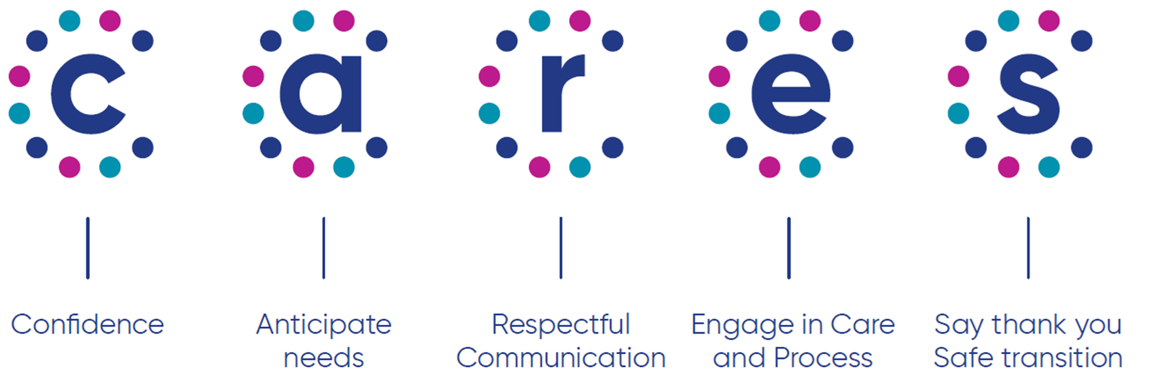
Why it matters: Trust is the foundation of every clinical relationship.
Confidence—both demonstrated and developed—creates psychological safety, strengthens trust, and encourages patients to actively participate in their care.
Skill:
Demonstrates composure, credibility, and belief in self, team, and organization. Builds confidence in patients, families, and colleagues to reduce power dynamics and foster collaboration.
Why it matters: Understanding the patient’s perspective is essential to safe and effective care.
Anticipating needs requires empathy, presence, and the ability to recognize both spoken and unspoken concerns.
Skill:
Proactively identifies emotional, clinical, and process needs through active listening and awareness. Aligns care delivery with individual perspectives, health literacy, and lived experiences.
Why it matters: Communication is not just what we say—it’s how we say it.
Every interaction reflects professionalism, compassion, and respect.
Skill:
Uses clear, intentional language, tone, and body language to create a respectful and supportive environment. Maintains consistency and avoids judgment, even in high-pressure situations.
Why it matters: Patients who are engaged are safer, more confident, and more likely to follow their care plans.
Skill:
Invites patients into the care process through clear explanations, shared decision-making, and teach-back. Ensures understanding and reinforces key information to support retention and adherence.
Why it matters: The final moments of an interaction shape what patients remember—and what happens next.
Skill:
Closes interactions with clarity, confidence, and care. Reinforces next steps, reduces uncertainty, and ensures continuity across the care journey while leaving a lasting positive impression.
The Outcomes
Organizations implementing CARES™ have demonstrated measurable improvements in:
CARES™ is the foundation—but sustainable performance requires alignment across the system.
Healthcare Experience Foundation partners with organizations to:

4 min read
Win Howard : May 6, 2026, 5:31:04 PM
Culture as a Core Responsibility of the C-Suite in Healthcare Overview Organizational culture is often treated as a secondary priority in...

2 min read
 Katie Owens : Apr 28, 2026, 10:48:45 AM
Somewhere in the timeline of initiatives to advance quality, safety and experience, Rounding turned into a task. Check the box. Ask the questions....

7 min read
Katie Owens : Apr 24, 2026, 12:59:20 AM
The journey from hospital to home represents a critical transition point in a patient's healthcare experience. While the acute medical needs of...
1 min read
 HXF Events : Jun 5, 2026, 5:46:52 PM
Data to Differentiation: OAS CAHPS and Safety Lessons That Drive Superior Patient Experiences September 2–4, 2026 • Monterey Conference Center ...